
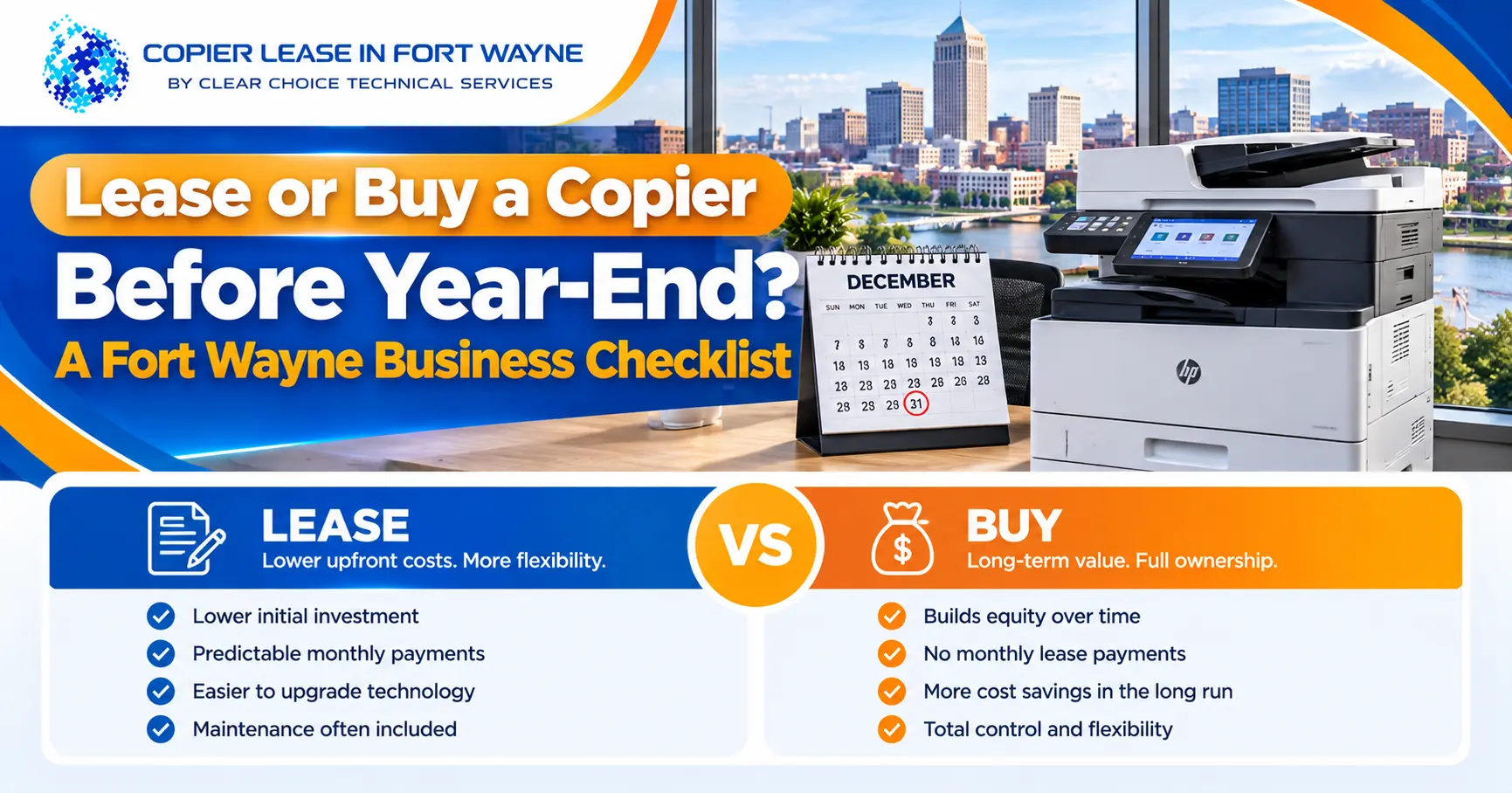
Copier Lease vs Buy in Fort Wayne: Which Wins by Year-End?
December is when copier decisions get rushed. Budgets close, the old machine jams one more time, and someone asks whether a new copier could lower this year’s tax bill. The short answer to the copier lease vs buy question: lease if you want predictable monthly costs and easy upgrades, and buy (or use a $1 buyout lease) if you want to own the machine and claim Section 179 before December 31.
This checklist walks Fort Wayne office managers, owners, and procurement staff through the costs, the tax rules, and the contract terms to check before year-end. It reflects what our technicians at Clear Choice Technical Services see when servicing leased and owned copiers across northeast Indiana.
TL;DR: Leasing a copier is usually better for small businesses that want low upfront cost, bundled service, and new equipment every 3–5 years. Buying is usually better for offices with steady print volume that keep equipment 5 years or longer and have cash or financing ready. A copier bought or financed with a $1 buyout lease can qualify for the Section 179 deduction (up to $2,560,000 for 2026) if it is placed in service by December 31, 2026. A fair market value (FMV) lease does not qualify for Section 179, but its monthly payments are generally deductible as a business expense.
Key Takeaways
- The 2026 Section 179 deduction limit is $2,560,000, and it begins phasing out once total qualifying equipment purchases exceed $4,090,000.
- To claim Section 179 for 2026, a copier must be purchased, delivered, and placed in service by December 31, 2026; ordering it in December is not enough.
- A $1 buyout lease is treated like a purchase for tax purposes, so it can qualify for Section 179; an FMV lease cannot.
- Most copier leases run 36 to 60 months, and many include a service agreement billed on a cost-per-page basis.
- Buying a copier typically costs less over 5+ years, while leasing keeps cash free and makes upgrades easier.
- Section 179 cannot exceed your business’s taxable income for the year, so confirm the benefit with your accountant before you sign.
What is the difference between leasing and buying a copier?
Buying a copier means you pay for it upfront or through financing and own it outright. Leasing means you pay a fixed monthly amount to use it for a set term, usually 36 to 60 months. At the end of a lease, you return, renew, upgrade, or buy the machine, depending on the lease type.
Two lease types matter most:
- A fair market value (FMV) lease is a lease with lower monthly payments and the option to buy the copier at its market value when the term ends. It is treated as a rental for tax purposes.
- A $1 buyout lease is a lease where you own the copier for $1 at the end of the term. It is treated as a financed purchase for tax purposes.
Copier lease vs buy: which costs less?
Buying usually costs less over the life of the copier, while leasing costs less upfront. Lease payments include financing charges, so the total paid over a 60-month term typically exceeds the purchase price. Leasing makes sense when cash flow, uptime, and upgrades matter more than the lowest total cost.
| Factor | Lease (FMV) | $1 buyout lease | Buy outright |
| Upfront cost | Low (first payment) | Low (first payment) | Full price |
| Total cost over 5 years | Highest | Middle | Lowest |
| Ownership | No | Yes, at end of term | Yes, immediately |
| Section 179 eligible | No | Yes | Yes |
| Tax treatment | Payments expensed | Depreciate or Section 179 | Depreciate or Section 179 |
| Upgrade flexibility | High | Low | Low |
| Service | Often bundled | Separate agreement | Separate agreement |
Example (illustrative, verify with current quotes): A mid-volume color multifunction copier priced at $9,000 might lease for about $190 per month over 60 months, or $11,400 total. Buying saves roughly $2,400 over five years, but leasing frees $9,000 in cash today. Service and supplies are usually billed separately in both cases on a cost-per-page plan.
Is it better to buy or lease a copier for a small business?
For most small businesses printing under 10,000 pages a month, a small business copier lease is the easier choice because it bundles service and protects cash. Buying is better if your print volume is steady, you plan to keep the machine for at least 5 years, and you can use the tax deduction this year.
Leasing makes sense when you:
- Want a predictable monthly cost with service included
- Expect to grow or change print needs within 3–4 years
- Prefer not to tie up 5,000–15,000 in equipment
Buying makes sense when you:
- Print steady volumes and keep equipment 5–7 years
- Have taxable profit this year that Section 179 can offset
- Want no long-term contract or end-of-lease fees
How does Section 179 copier apply to a copier bought before year-end?
Section 179 is a federal tax provision that lets a business deduct the full purchase price of qualifying equipment in the year it is placed in service, instead of depreciating it over several years. Copiers bought outright or financed with a $1 buyout lease qualify. For 2026, the limit is $2,560,000, with a phase-out starting at $4,090,000.
Two limits trip people up. First, Section 179 cannot exceed your business’s taxable income for the year. Second, an FMV lease does not qualify, though those payments are generally deductible as operating expenses. Report Section 179 on IRS Form 4562, and confirm your situation with a tax professional.
What should be on your year-end copier checklist?
Start this checklist by early November so delivery and installation finish before December 31. Fort Wayne dealers often see a December rush, and lead times for specific models can stretch to several weeks.
- Pull 12 months of page counts. Check your current copier’s meter for monthly black-and-white and color volume.
- Read your current lease. Find the end date, buyout terms, and the notice period for non-renewal (often 30–90 days).
- Talk to your accountant. Confirm whether Section 179 would reduce your 2026 taxes, given your taxable income.
- Choose the structure. FMV lease, $1 buyout lease, or outright purchase, based on the comparison above.
- Get at least two quotes. Compare the monthly payment, term length, cost per page, and included toner.
- Check the fine print. Look for automatic renewal clauses, annual payment increases, and return shipping fees.
- Schedule delivery and setup before mid-December. Include network, scanning, and security configuration.
- Save the delivery and installation paperwork. It documents the placed-in-service date for your tax return.
What should Fort Wayne businesses look for in a copier lease?
A good Fort Wayne copier lease pairs a fair monthly rate with fast local service. Ask how quickly a technician can arrive on-site, whether parts are stocked locally, and who handles the service agreement: the dealer or a third party. Response time matters more than a few dollars a month when a copier goes down during payroll week.
Conclusion
The copier lease vs buy decision comes down to cash, timing, and how long you’ll keep the machine. Lease for predictable costs and easy upgrades. Buy, or use a $1 buyout lease, if you want ownership and a 2026 Section 179 deduction, and make sure the copier is in service by December 31.
Ready to decide before December 31? Clear Choice Technical Services gives Fort Wayne businesses dependable copying and printing with low-cost leasing options and responsive local service. We handle delivery, installation, and setup, so your new copier is placed in service before the year-end deadline.
Our pricing is clear and our payment options are affordable and flexible. Whether you need a copier for a short-term project or a multi-year lease, we’ll match the plan to your page volume and budget.
Schedule your free lease vs buy consultation at www.copierleasefortwayne.com, or call Clear Choice Technical Services at (260) 204-0032 to compare your lease and purchase options.
